
Build a Scoring Matrix for Market Selection
In this step-by-step guide, we show you how to build your own weighted scoring system based on your priorities.

Choosing your next market shouldn’t feel like betting on a roulette wheel. Yet, many companies expand based on gut feel, recent hype, or where a competitor went and then wonder why traction never comes. At EntryMapper, we’re big fans of matrices, not just because they look neat in a slide deck, but because they cut through the noise, remove bias, and create alignment across your team. In this step-by-step guide, we’ll show you how to build your own custom weighted scoring matrix for market selection, complete with a free template you can use right away.
Want to skip to the spreadsheet? Download the EntryMapper Market Selection Workbook, our free, customizable tool designed to help you shortlist the right markets in record time.
Why Use a Scoring Matrix for Market Selection?
When you’re planning international expansion or selecting your next domestic target market, decision-making can get political fast. A scoring matrix gives you data over opinion and reduces emotion-based decisions. It helps you align your team, so everyone evaluates markets based on the same agreed-upon factors. It promotes efficient prioritization and adaptability, because your matrix evolves as priorities change or new data becomes available.
This structured approach is the foundation of a market scoring framework, one of the most reliable ways to compare opportunities side-by-side.
Step-by-Step: Building Your Custom Matrix
Step 1: Define Your Selection Criteria
Start by listing the factors that matter most to your business. Common examples include:
- Total Addressable Market (TAM) – potential revenue size
- Ease of Doing Business – regulatory environment, bureaucracy
- Regulatory Barriers – licensing, import/export restrictions
- Competition Intensity – number and strength of competitors
- Cultural Fit – alignment with brand and product positioning
- Existing Network – partners, distributors, or clients already present
Tip: Keep the list to 5–7 key criteria to avoid overcomplicating the process.
Step 2: Assign Weights to Each Criterion
Not every factor should carry the same influence. If market size is crucial, give it a higher weight. If cultural fit is less important right now, give it less.
Step 3: Score Each Market
For each market under consideration, rate it against every criterion using a consistent scale (e.g., 1 to 5, where 5 is best). Base these scores on real data (market research reports, competitive analysis, and trusted sources).
Step 4: Calculate Weighted Totals
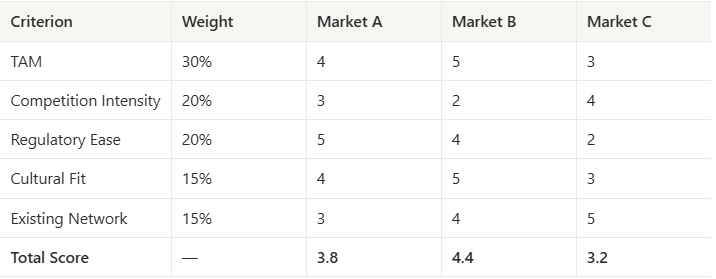
Multiply each score by its weight, then sum the results for each market. Here’s a simplified example:
Step 5: Discuss, Decide, and Revisit
The scoring matrix is a decision-support tool, not a decision-maker. Use it to narrow down your shortlist, but remember to revisit it quarterly. Market conditions, regulations, and competition can change quickly.
A scoring matrix is one part of a broader market selection framework. To make truly informed decisions, you also need deep market analysis, risk assessment and validation. This is where the EntryMapper comes in. Our Market Selection Workbook is a preview of our matrix and brings together your scoring matrix, data analysis, and prioritization into one streamlined, shareable tool.
Download Your Free Scoring Matrix Template
We’ve done the heavy lifting so you can focus on what matters. Our free Market Selection Workbook lets you:
- Input your own criteria and weights
- Score multiple markets side-by-side
- Auto-calculate rankings
- Export an investor-ready snapshot
Frequently asked questions

The best market is not always the largest one. EntryMapper uses data-backed prioritisation across market size, growth, customer fit, competition, regulation and go-to-market feasibility to help companies identify where they have the strongest chance to win.
We support your go-to-market planning by providing the research and insights needed for a solid strategy. We identify your ideal customer segments in the new market, analyze how competitors reach those customers, and suggest effective sales and marketing channels for your situation. Our Expansion Playbook includes tailored recommendations on positioning, partnerships, and even a phased rollout plan. Essentially, we give you a data-backed blueprint so you can execute your GTM strategy with confidence.
EntryMapper works with startups, scaleups, larger companies and investors that need clarity before making expansion, investment or go-to-market decisions. We are especially relevant for teams considering new countries, new verticals, new customer segments, new partner routes or fundraising-related market positioning.
EntryMapper helps companies make better market-entry and go-to-market decisions through structured research, competitive analysis and data-backed recommendations. We help answer questions such as where to expand, which markets to prioritise, how the competitive landscape works, which customer segments to focus on, which partners matter, and what the first go-to-market steps should be.
You should work with EntryMapper before committing significant time, budget or team capacity to a new market. Typical moments include choosing between expansion markets, validating whether there is real white space, preparing for investor or board discussions, defining an ideal customer profile, or building a practical go-to-market plan.
Continue reading




Strategic clarity for market entry
We help companies, investors and advisory teams make expansion decisions with more clarity, stronger evidence and better execution readiness.

Book a 30-min market entry consultation
Choose a convenient time to speak with EntryMapper. We’ll discuss your expansion goals and recommend the next best steps.

30 minutes

Google Meet


.svg)